Mutation Testing for AI-Generated Tests: Grade the Tests Before You Trust Them

qabash.comAmbassador
Nov 22, 2026
Quick answer
Mutation testing grades a test suite by making small deliberate bugs ("mutants") in the code, such as flipping < to <= or - to +, and rerunning the tests. If a test fails, the mutant is killed; if all tests pass, it survived, which shows a behaviour no test checks. For AI-generated tests it's the most direct quality check available, because AI tests often execute code without asserting on its results. Run it on critical modules, look at survivors, and add tests with exact expected values from the requirement.

An assistant wrote three tests for a pricing function. They pass. Line coverage is 100%. The PR looks finished.
Then mutation testing changed one character in the code, so that a 10% coupon raised the price by 10%, and all three tests still passed.
That’s the gap this guide is about. AI tools now write a large share of new tests, and coverage can’t tell you whether those tests would notice a bug. Mutation testing for AI-generated tests can. Below is how it works, a real run with mutmut and pytest, and how to use it without drowning in noise.
Why coverage can’t grade AI-written tests
Code coverage measures what the tests executed. It says nothing about what they checked.
A test that calls a function and asserts isinstance(result, float) gets full coverage of that function. So does a test that asserts the exact correct price. Coverage scores them the same.
AI-generated tests lean toward the first kind. Asked to “write tests for this function,” a model reads the implementation and writes tests that exercise it: types, comparisons, “doesn’t crash,” the error path. Those are reasonable-looking tests that are easy to write without knowing the right answers. They often lack exact expected values from the requirement, which are the assertions that catch real bugs.
You need a metric that rewards checking, not running.
What is mutation testing?
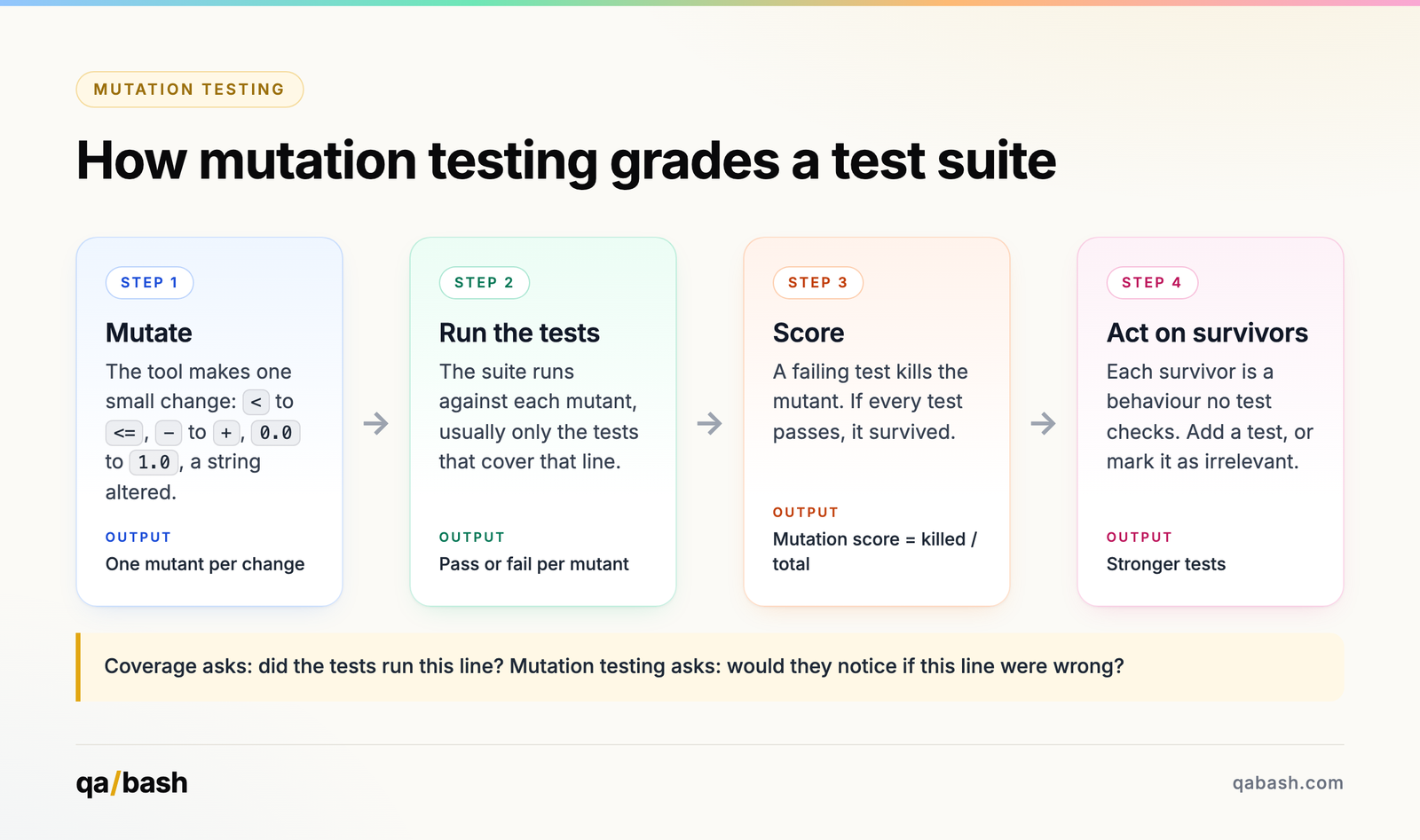
Each mutant is a small, realistic bug: the kind an off-by-one or a typo produces. If your tests can’t detect a bug you introduced on purpose, they won’t detect the same bug introduced by accident.
A worked example: AI-written tests vs mutmut
The code under test applies a coupon and a member discount:
# pricing.py: discount rules for the checkout
def final_price(price: float, coupon_pct: int, is_member: bool) -> float:
    """Apply a coupon (0-50%), then 5% off for members. Never below zero."""
    if coupon_pct < 0 or coupon_pct > 50:
        raise ValueError("coupon must be between 0 and 50")
    total = price * (100 - coupon_pct) / 100
    if is_member:
        total = total * 0.95
    return round(max(total, 0.0), 2)
The tests an assistant wrote for it:
# test_pricing.py: tests an AI assistant wrote. 100% line coverage, all green.
import pytest

from shop.pricing import final_price


def test_returns_a_number():
    assert isinstance(final_price(100, 10, False), float)


def test_member_price_is_lower():
    assert final_price(100, 10, True) < final_price(100, 10, False)


def test_invalid_coupon_raises():
    with pytest.raises(ValueError):
        final_price(100, 80, False)
Every line runs. Every test passes. Now run mutmut. The project uses a src/ layout, so tell mutmut where the code is:
# pyproject.toml
[tool.mutmut]
source_paths = ["src/"]
pythonpath = ["src"]

[tool.pytest.ini_options]
pythonpath = ["src"]
pip install mutmut pytest
mutmut run
mutmut results
Result with mutmut 3.8.1: 27 mutants, 15 killed, 12 survived. A mutation score of 56%, from a suite with 100% line coverage.
Reading the survivors
mutmut show <mutant-name> prints the diff of any survivor. A few of the twelve:
| Survivor | What the code now does | Why the AI tests missed it |
|---|---|---|
100 - coupon_pct → 100 + coupon_pct |
A 10% coupon raises the price 10% | No test checks an exact price; members are still cheaper than non-members |
coupon_pct < 0 → coupon_pct <= 0 |
A 0% coupon (no coupon) is rejected | No test uses coupon 0 |
coupon_pct < 0 → coupon_pct < 1 |
Same bug, different spelling | Same gap at the lower boundary |
max(total, 0.0) → max(total, 1.0) |
Any price under 1.00 becomes 1.00 | No test with a small or negative price |
round(..., 2) → round(..., 3) |
Prices come back with 3 decimal places | No test with a price that needs rounding |
The first one is the headline. A coupon that increases the price would reach production with a fully green, fully covered suite, because test_member_price_is_lower compares two wrong numbers and finds the right relationship.
That’s the typical shape of AI-test weakness: relationships and types instead of exact values, happy-path inputs instead of boundaries.
Fixing the suite: tests from the requirement
The docstring is the requirement: coupons from 0 to 50%, member discount after the coupon, never below zero, prices to two decimals. Tests written from it, with exact oracles:
# test_pricing_requirements.py: tests written from the pricing rules, with exact oracles
import pytest

from shop.pricing import final_price


@pytest.mark.parametrize("price, coupon, member, expected", [
    (100, 0, False, 100.00),   # lower coupon boundary is valid
    (100, 50, False, 50.00),   # upper coupon boundary is valid
    (100, 10, False, 90.00),   # coupon reduces the price
    (100, 10, True, 85.50),    # member discount applies after the coupon
    (19.99, 15, True, 16.14),  # rounding to 2 decimal places
    (0.5, 0, False, 0.50),     # small prices are not floored up
])
def test_exact_prices(price, coupon, member, expected):
    assert final_price(price, coupon, member) == expected


@pytest.mark.parametrize("coupon", [-1, 51])
def test_out_of_range_coupons_are_rejected(coupon):
    with pytest.raises(ValueError, match="between 0 and 50"):
        final_price(100, coupon, False)


def test_price_never_goes_below_zero():
    assert final_price(-10, 0, False) == 0.0
Rerun: 12 tests pass, and 26 of 27 mutants are killed (96%). Same code, same coverage, a very different suite.
Notice what changed. Not the number of tests, but the oracles: exact expected values, both boundaries of every range, and the edge cases named in the requirement.
Which surviving mutants can you ignore?
The last survivor:
-        raise ValueError("coupon must be between 0 and 50")
+        raise ValueError("XXcoupon must be between 0 and 50XX")
The test uses match="between 0 and 50", a substring search, so extra characters around the message don’t fail it. Does that matter? Not for pricing. Making the test match the exact full message would kill the mutant and make the test brittle for no gain.
That’s a normal outcome. Some mutants don’t matter, and some are equivalent: they change the code without changing its behaviour at all. Chasing 100% mutation score wastes time. Treat survivors as questions:
- Would a real bug look like this? If yes, add a test.
- Does the behaviour matter to anyone? Log messages and error text often don’t.
- Is it equivalent? If the behaviour can’t differ, mark it and move on.
Running mutation testing in CI without the pain
Mutation testing is expensive: it reruns the tests once per mutant. That’s trivial for one module (this example ran at well over 100 mutants per second) and slow for a whole codebase. Use it strategically:
| Strategy | How |
|---|---|
| Critical modules only | Pricing, auth, permissions, data transforms. Not UI glue. |
| Changed code only | Mutate files touched by the PR, not the whole repo |
| Nightly full runs | Track the score over time per module |
| Score as a signal, not a gate | Alert on drops; avoid hard thresholds that encourage gaming |
| Review survivors on AI-heavy PRs | Especially where an assistant wrote both code and tests |
The last row is the high-value habit for 2026 and beyond. When an AI-written PR includes AI-written tests, a quick mutation run on the changed module tells the reviewer in minutes whether the tests would catch anything.
Mutation testing tools by language
| Language | Tool | Notes |
|---|---|---|
| Python | mutmut | Works with pytest; 3.x uses pyproject.toml config |
| JavaScript / TypeScript | Stryker Mutator | Integrates with Jest, Vitest, Mocha and others |
| C# / .NET | Stryker.NET | Same family as Stryker for JS |
| Java / JVM | PIT (pitest) | Mature, fast, Maven and Gradle plugins |
| Others | Language-specific tools exist for Go, Rust, Ruby and more | Maturity varies; check maintenance status |
Common mistakes testers make
| Mistake | Why it happens | Better approach |
|---|---|---|
| Treating coverage as test quality | It’s easy to measure | Use mutation score on critical code |
| Mutating the whole repo in every PR | “More is better” | Critical or changed modules only |
| Chasing 100% mutation score | Numbers invite targets | Triage survivors; ignore equivalent and irrelevant ones |
| Asking the AI to “add tests until mutants die” | Seems efficient | It may write tests that pin implementation details; derive oracles from the requirement |
| Asserting relationships only | “A is less than B” feels like a check | Assert exact expected values |
| Skipping boundaries | Happy path feels complete | Test both edges of every range |
Interview questions
Beginner
What is mutation testing?
Injecting small bugs into code and checking whether the tests fail.
What is a killed mutant?
One that made at least one test fail.
What does a surviving mutant mean?
A change in behaviour no test detected.
Why isn’t code coverage enough?
It measures execution, not whether results were checked.
Intermediate
What is a mutation score?
Killed mutants divided by total (sometimes excluding equivalent ones).
What is an equivalent mutant?
A change that doesn’t alter observable behaviour, so no test can kill it.
Why do AI-generated tests often have low mutation scores?
They tend to assert types and relationships rather than exact expected values and boundaries.
How do you keep mutation testing fast?
Limit it to critical or changed modules and run full sweeps nightly.
Advanced
Should mutation score be a CI gate?
Usually as a trend or per-module floor, not a global hard gate, to avoid gaming.
How would you use mutation testing on an AI-written PR?
Mutate the changed module, review survivors, and require requirement-based tests for meaningful ones.
Can an LLM help kill mutants?
Yes, by proposing tests, but the expected values must come from the requirement, not from the current implementation.
Which mutants would you prioritize?
Arithmetic, comparison and boundary mutants in money, auth and data-integrity code.
How AI changes this
For years mutation testing was a niche practice: valuable, slow and hard to justify. AI changed the economics. Test writing is now cheap and abundant, so the scarce thing is knowing which tests are worth anything.
Mutation testing is the most direct answer to that. Expect it to show up in 2027 review workflows as a standard check on AI-heavy PRs, and expect AI tools to use mutation results to improve their own tests. That loop works well only if expected values come from requirements; otherwise the tests just learn to agree with the code.
Automation can execute tests. Thinking still belongs to testers.
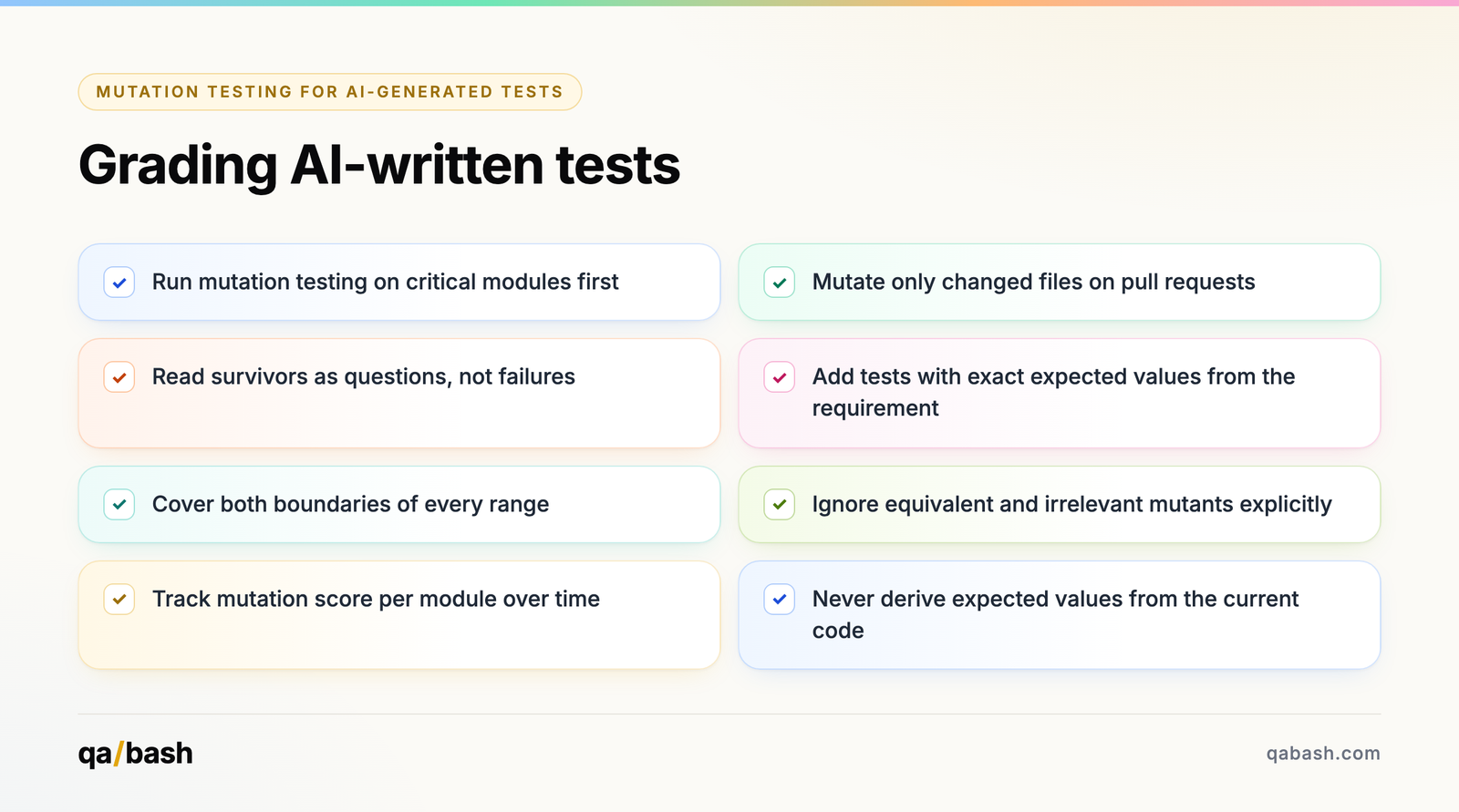
Best practices checklist
Conclusion
Mutation testing for AI-generated tests turns “the tests pass” into a question you can answer: would they notice a bug?
In the example, a fully covered AI-written suite let a price-raising coupon survive. Six requirement-based cases with exact values took the score from 15 of 27 to 26 of 27. AI makes tests cheap. Mutation testing tells you which ones are worth keeping.
The best testers don’t just find bugs. They uncover risks.
Keep testing. Keep learning. Keep questioning.

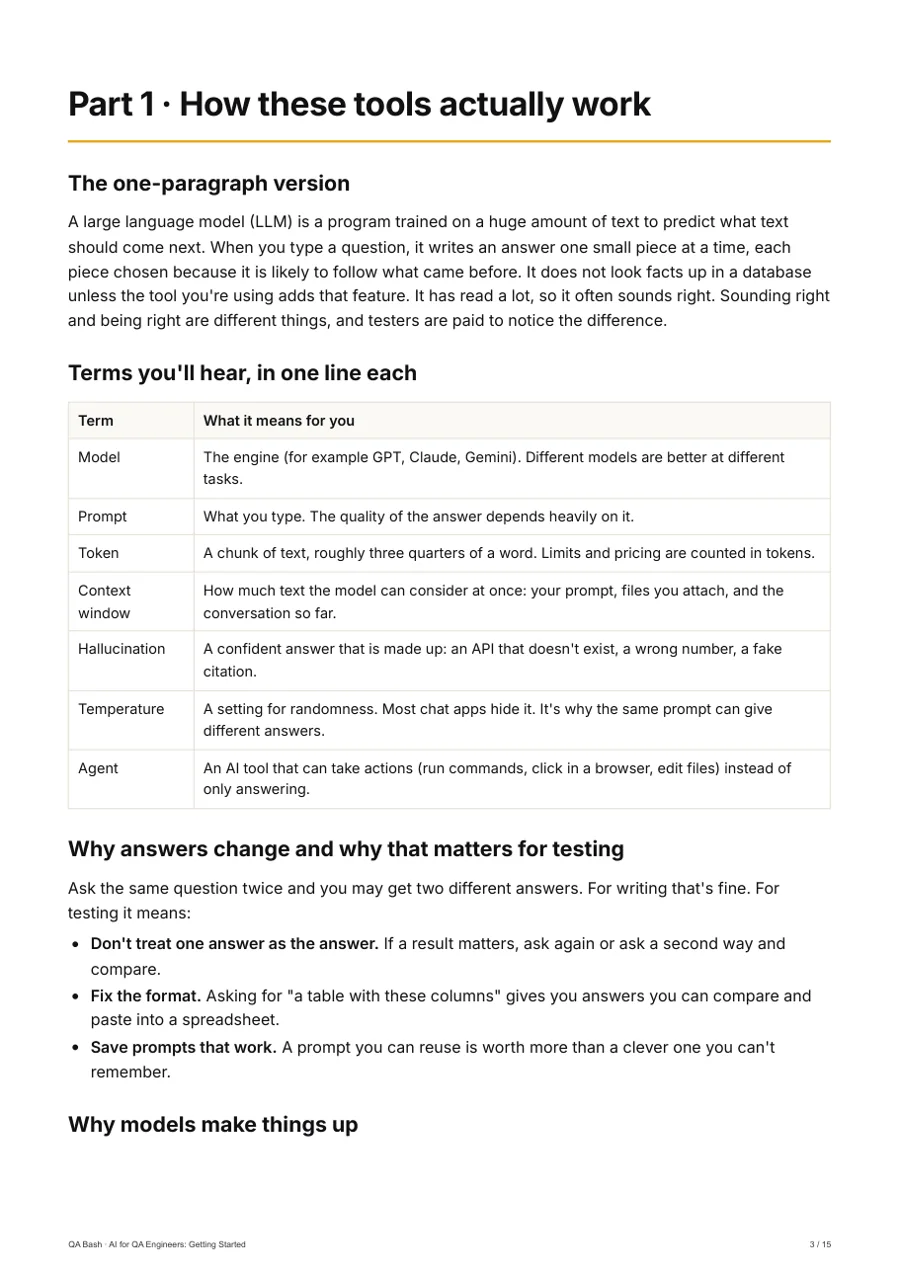
Go deeper · QA Bash kit
AI for QA Engineers: Getting Started
Use AI tools in your testing work, with prompts that work and checks that keep you safe.
0–1 yrs · 10 testing workflows
₹299₹374
Rate this article
9.3/10 average · 29 ratings
Discussion
Be the first to weigh in
Your question or experience helps the next tester who reads this. Sign in and earn +25 XP for every approved comment or reply.
Written by

Frequently asked questions.
Keep reading