Newsletter
One email. Every week. Pure signal.
The week in quality engineering — skip an issue, and you'll wish you hadn't.
20K+ engineers already reading
Writing Test Cases for Automation: How to Make Every Case Automation-Ready

Oct 6, 2026
Test cases written for automation should be atomic (one behaviour each), independent (they create their own data and run in any order), deterministic (no timing, date or shared-state luck), have specific, machine-checkable expected results, and be valuable enough to repay their maintenance. Structuring them as Given, When, Then and prioritising critical business flows first makes them translate directly into reliable automated tests.

Most flaky, slow, unmaintainable automation suites were doomed before anyone wrote code. The test cases they were built from had twelve steps, three hidden dependencies, test data that only existed on one tester’s laptop, and expected results like “page works correctly”. Automating a weak test case just makes it fail faster.
This guide is about writing test cases for automation: cases that turn into fast, reliable, readable automated tests with little translation. It covers the five properties of an automation-ready test case, a before and after rewrite, what not to automate, and a checklist you can use in review.
If you want general test design techniques such as boundary values and equivalence partitioning, start with test case design techniques senior QA engineers apply. This post picks up where design ends.
What makes a test case automation-ready?
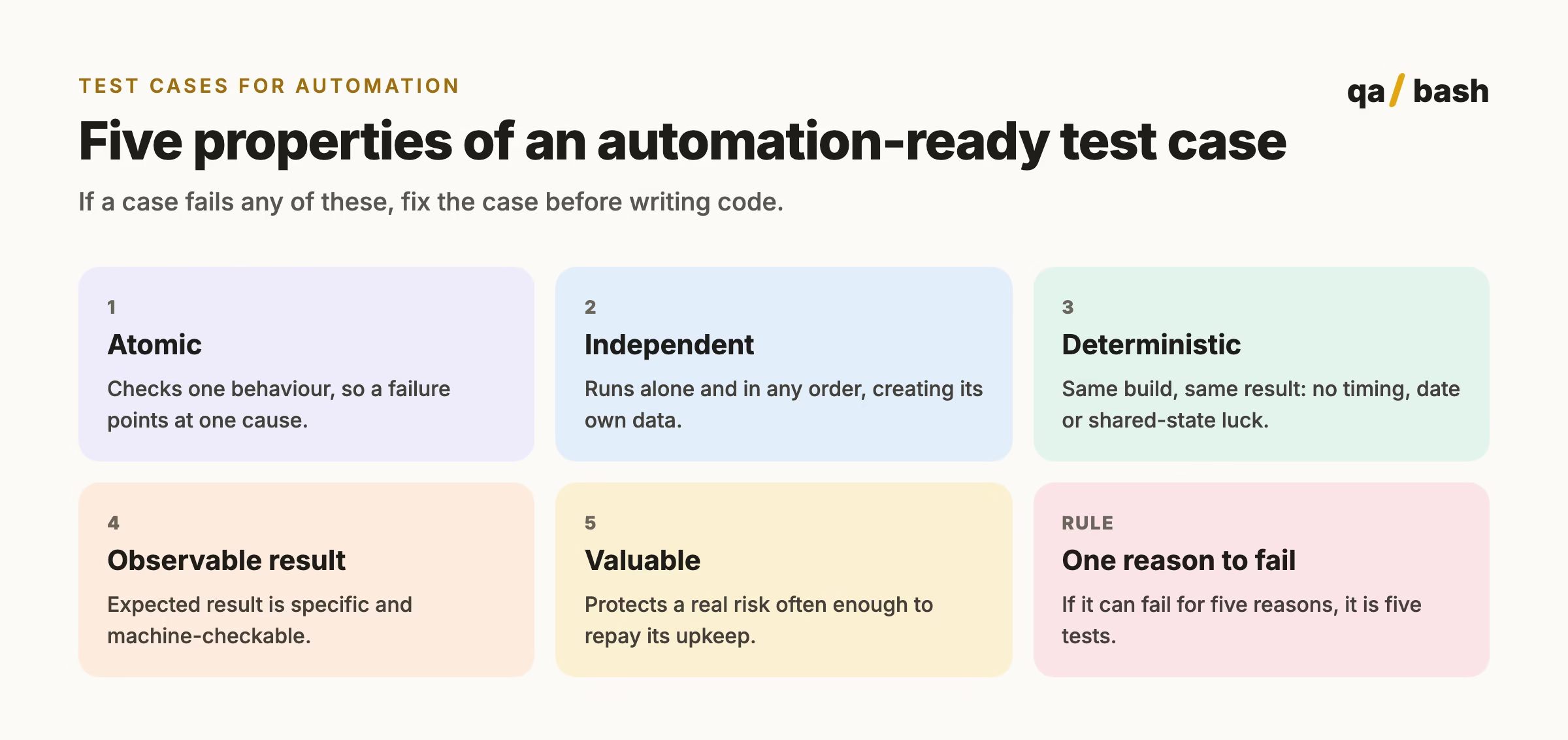
1. Atomic: one behaviour per test
A test that logs in, searches, adds to cart, applies a coupon and checks out tells you almost nothing when it fails. Split it so each test verifies one behaviour, and set up the earlier steps through the API or fixtures instead of the UI.
2. Independent: no hidden order or shared state
Each test creates the data it needs and cleans up after itself. If test B only passes after test A, you cannot run them in parallel, rerun one failure, or trust either result.
3. Deterministic: same input, same result
- Use fixed or generated-per-run data, never “whatever is in staging”.
- Freeze or control dates and times where the behaviour depends on them.
- Wait for conditions, never for fixed durations.
- Mock third-party services that are not under test.
4. Specific, observable expected results
“Order is placed successfully” cannot be automated. “Order confirmation shows order number, total is ₹1,180 including 18% GST, and status in the orders API is PAID” can. Each expected result should map directly to an assertion.
5. Worth automating
Automation has a cost every time the product changes. Automate cases that protect important behaviour and run often; leave the rest to exploratory or one-off checks.
Before and after: rewriting a test case for automation
| Before | After | |
|---|---|---|
| Title | Verify checkout | Coupon SAVE10 reduces cart total by 10 percent |
| Preconditions | User is logged in and has items | New user created via API; cart with one item priced 1,000 via API |
| Steps | Login, search item, add to cart, go to cart, apply coupon, check out, verify | Open cart; apply coupon SAVE10 |
| Test data | Use test account | Coupon SAVE10 (10 percent, active); item SKU QA-101 |
| Expected result | Checkout works and discount applied | Discount line shows 100; total shows 900; coupon field shows “Applied” |
| Independent | Depends on existing account and stock | Creates and deletes its own user and cart |
The rewritten case maps almost line for line to code:
def test_coupon_reduces_cart_total(api, page):
    user = api.create_user()
    api.add_to_cart(user, sku="QA-101", price=1000)

    cart = CartPage(page).open_as(user)
    cart.apply_coupon("SAVE10")

    assert cart.discount() == 100
    assert cart.total() == 900
    assert cart.coupon_status() == "Applied"
Structure test cases with Given, When, Then
Writing cases as Given (state), When (action), Then (observable result) keeps them atomic and makes the automation obvious, whether or not you use a BDD tool.
Given a cart containing one item priced 1,000
When the user applies coupon SAVE10
Then the discount is 100
And the cart total is 900
What not to automate
| Case | Why | Instead |
|---|---|---|
| One-off checks | Upkeep never pays back | Run manually once |
| Rapidly changing UI | Tests break every sprint | Wait until the design settles; test the API now |
| Visual look and feel | Hard to assert reliably | Visual testing tools or review |
| Exploratory scenarios | Value is in human judgment | Time-boxed exploratory sessions |
| Low-risk, rarely used paths | Cost outweighs protection | Cover in occasional manual regression |
Prioritise automation by risk
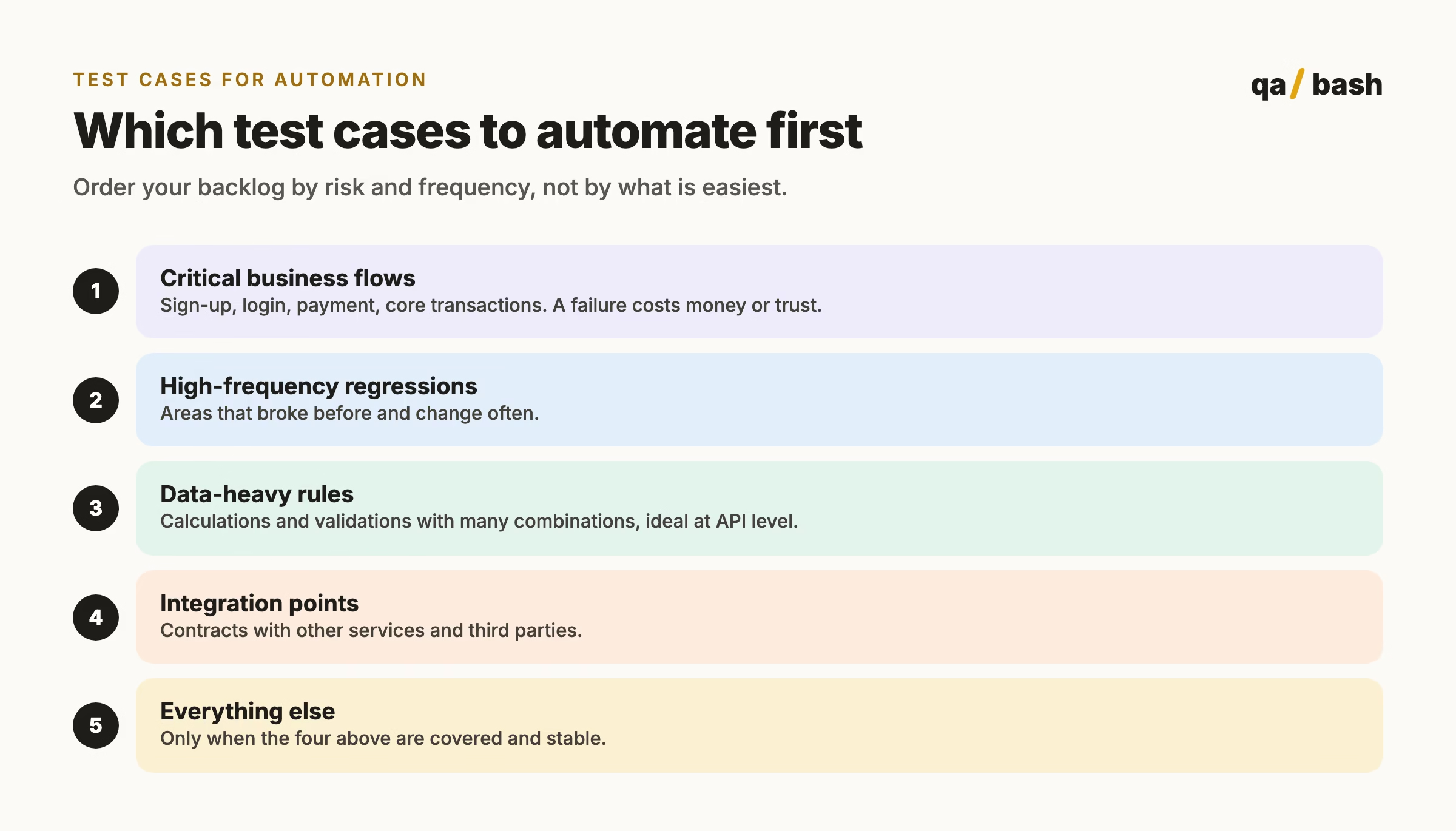
Push each case to the lowest layer that can catch the problem. Most business rules belong in API or unit tests; keep UI automation for journeys a user actually takes.
Automation-ready test case checklist
- Title states the single behaviour under test.
- Preconditions are created by the test, preferably through API or fixtures.
- Steps are short and contain no verification hidden inside them.
- Test data is explicit, unique per run or fixed, and safe to share.
- Every expected result is specific and checkable by code.
- The case runs alone, in any order, and in parallel.
- Dates, times and third parties are controlled.
- There is a clear reason this case is worth automating.
To make sure the cases you write pass peer review as well as automation, read writing test cases that hold up under review. Need a fast first draft? The free AI Test Case Generator outputs structured cases you can then tighten with this checklist.
Rate this article
8.1/10 average · 36 ratings
Discussion
Start the conversation
What do you think about this article? Share your experience, ask a question, or add to the discussion.

He’s a builder of communities, a collector of questions, and a relentless challenger of assumptions. While others chase answers, he chases better questions. While others talk about the future of testing, he quietly helps create it.
Frequently asked questions.
How do you write test cases for automation?
Make each case check one behaviour, create its own preconditions and data, avoid timing and shared-state dependencies, and state a specific expected result that maps directly to an assertion.
What is an atomic test case?
A test case that verifies a single behaviour, so when it fails there is only one likely cause. Long end-to-end flows should be split into several atomic tests.
Related articles
17 Common Playwright Mistakes That Cause Flaky Tests + Solutions
Addressing common Playwright mistakes prevents flaky tests and slow feedback loops, ensuring robust,…
9 min
Playwright Interview Questions for QA Engineers: A Practitioner’s Guide
Playwright interview questions for QA engineers often assess practical application, framework design, and…
15 min