SDLC vs STLC: Where They Overlap and What QA Owns in Each

Ishan Dev ShuklCommunity Council
Jul 28, 2024
Software Development Life Cycle (SDLC)
Definition: SDLC, or Software Development Life Cycle, is a systematic process that outlines the steps involved in planning, creating, testing, deploying, and maintaining a software application. It serves as a roadmap for the development team, guiding them through various phases to ensure the successful delivery of a high-quality software product.

Phases of Software Development Life Cycle (SDLC)
- Planning: Define the project scope, goals, timelines, and resources.
- Analysis: Gather and analyze requirements to understand the needs of end-users.
- Design: Create a blueprint of the software, detailing system architecture and specifications.
- Implementation: Develop the actual code based on the design specifications.
- Testing: Verify the software against predefined requirements to identify and fix defects.
- Deployment: Release the software for use by end-users.
- Maintenance: Address bugs, add new features, and make improvements based on user feedback.
Key Characteristics of Software Development Life Cycle (SDLC)
- Iterative and Incremental: Allows for revisiting and refining phases as needed.
- Collaborative: Involves various stakeholders, including developers, project managers, and business analysts.
- Goal-Oriented: Aims to deliver a fully functional and high-quality software product.
Software Testing Life Cycle (STLC)
Definition: STLC, or Software Testing Life Cycle, is a subset of the SDLC focused specifically on the testing activities. It involves systematically planning, designing test cases, executing tests, and ensuring the software meets specified requirements before release.

Phases of Software Testing Life Cycle (STLC)
- Planning: Define the testing scope, objectives, resources, and timelines.
- Design: Develop test cases, scenarios, and data based on project requirements.
- Execution: Run the tests and identify defects in the software.
- Defect Reporting: Document and report identified defects to the development team.
- Retesting: Verify that defects have been fixed correctly.
- Regression Testing: Ensure that new changes haven’t adversely affected existing functionalities.
- Closure: Summarize testing results, create a test summary report, and assess testing completion.
Key Characteristics of Software Testing Life Cycle (STLC)
- Comprehensive: Focuses on testing the software thoroughly to identify and rectify defects.
- Collaborative: Requires coordination between testers, developers, and other stakeholders.
- Continuous: Runs concurrently with the development phase, ensuring ongoing quality assurance.
Software Development Life Cycle (SDLC) vs Software Testing Life Cycle (STLC)
| Aspect | SDLC | STLC |
|---|---|---|
| Focus | Encompasses the entire software development process. | Concentrates specifically on testing activities. |
| Objective | Aims to deliver a fully functional software product. | Aims to ensure the quality and reliability of the software through systematic testing. |
| Phases | Involves planning, analysis, design, implementation, testing, deployment, and maintenance. | Involves planning, design, execution, defect reporting, retesting, regression testing, and closure. |
| Stakeholders | Involves developers, project managers, business analysts, and testers. | Primarily involves testers, quality assurance professionals, and sometimes test automation engineers. |
In summary, while SDLC provides a holistic view of the software development process, STLC is essential for ensuring that the software meets quality standards through rigorous testing procedures. Both life cycles work collaboratively to deliver reliable and high-quality software to end-users.
Interview questions
Beginner
What is SDLC?
The Software Development Life Cycle: planning, building, testing, deploying and maintaining software.
What is STLC?
The Software Testing Life Cycle: the testing activities within the SDLC.
Name the main STLC phases.
Requirement analysis, test planning, test case design, environment setup, execution and closure.
Intermediate
How do SDLC and STLC overlap?
Testing activities run alongside development phases, starting from requirements.
What happens in the test closure phase?
Summarising results, metrics and lessons learned, and archiving test assets.
What are entry and exit criteria?
Conditions that must be met to start and to finish a testing phase.
Advanced
How does STLC change in Agile?
Phases are compressed into each sprint and repeated continuously.
What does QA own in each SDLC phase?
Requirement reviews, test planning, test design, execution, release sign-off input and production feedback.
Why start STLC during requirements, not after coding?
Early test analysis finds ambiguities and defects before they’re built in.
Go deeper · QA Bash kit
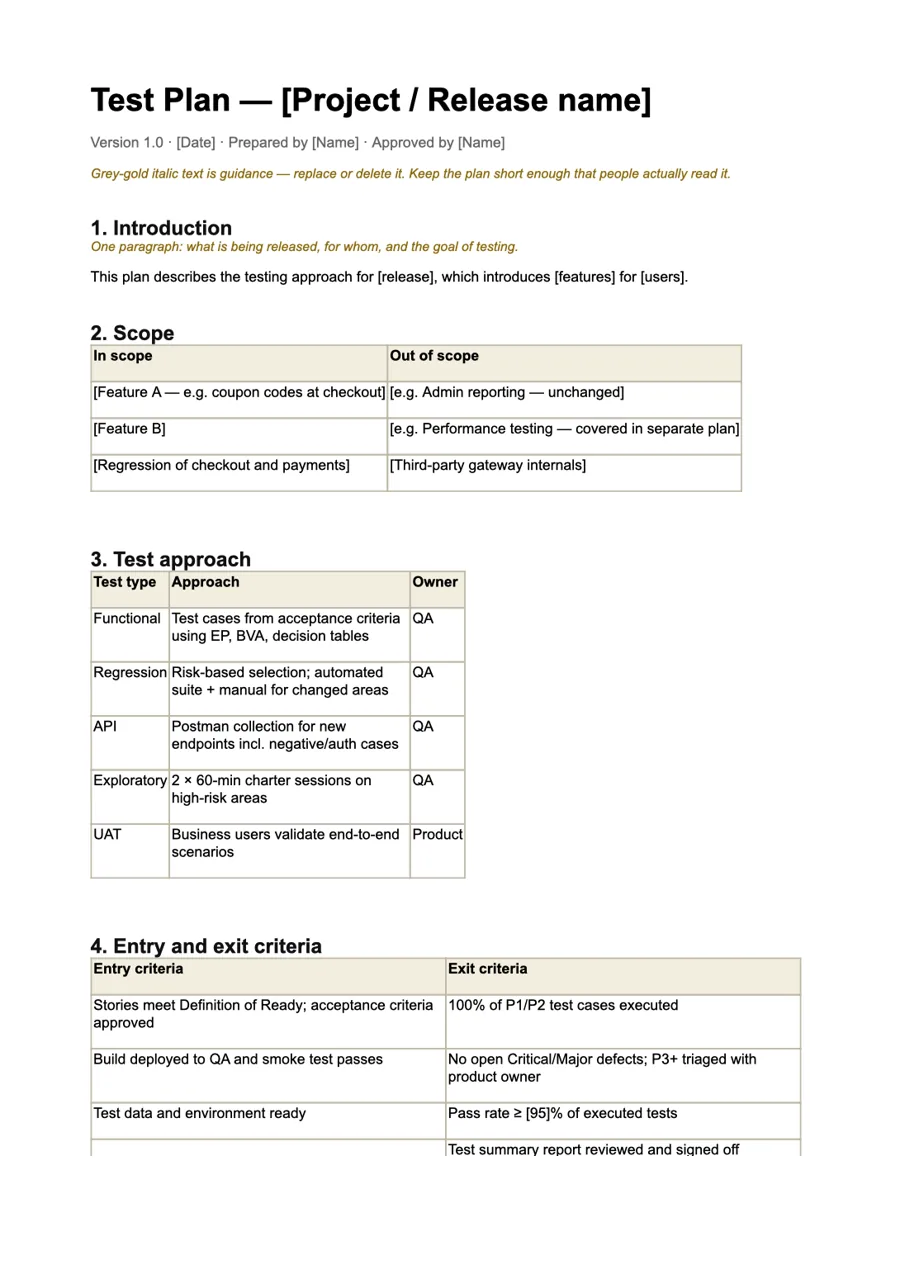
Manual Testing Templates Pack
Every document a QA team needs, ready to use.
0–1 yrs · 6 ready templates
₹249₹311
Rate this article
9.6/10 average · 36 ratings
Discussion
Be the first to weigh in
Your question or experience helps the next tester who reads this. Sign in and earn +25 XP for every approved comment or reply.
Written by

Testing EnthusiastGurugram, India
With 15+ years in test automation, Ironman specializes in building scalable automation frameworks, AI-driven testing strategies, and modern quality engineering practices. He writes about automation tools, testing architecture, and the future of QA. His mission is simple: help testers evolve into engineers who build quality into every system.
Keep reading