Software Testing Trends 2027: 10 Shifts QA Teams Should Prepare For

qabash.comAmbassador
Nov 24, 2026
Quick answer
The biggest software testing trends for 2027 are: testing AI agents by their actions and traces rather than their replies; testing MCP servers as APIs that models consume; treating prompt injection as a standard security test; verifying AI-generated code and tests with independent oracles and mutation testing; statistical release gates for non-deterministic features; evidence-driven testing for the EU AI Act's December 2027 deadline; LLM-generated test data behind validation gates; and self-healing tests that report instead of hiding. The common thread is that writing tests and code is getting cheap, so judging them is where testers add value.
Most trend lists are written backwards: pick a buzzword, then find a reason it matters. This one starts from changes that have already happened in 2026 (a new protocol version, a regulation with a fixed date, new defaults in test tools) and asks what they mean for testers in 2027.
No market-size numbers, no “X% of companies will.” Just ten software testing trends for 2027 with evidence, what each means in practice and a deep-dive guide for each one.
The one shift behind all ten trends
For decades, the expensive part of testing was writing and maintaining tests. In 2026 that cost collapsed. Assistants write tests, agents write code, tools repair locators and LLMs generate test data.
When production gets cheap, judgment gets valuable. Every trend below is a version of the same question: who decides what correct means, and how do they prove it?
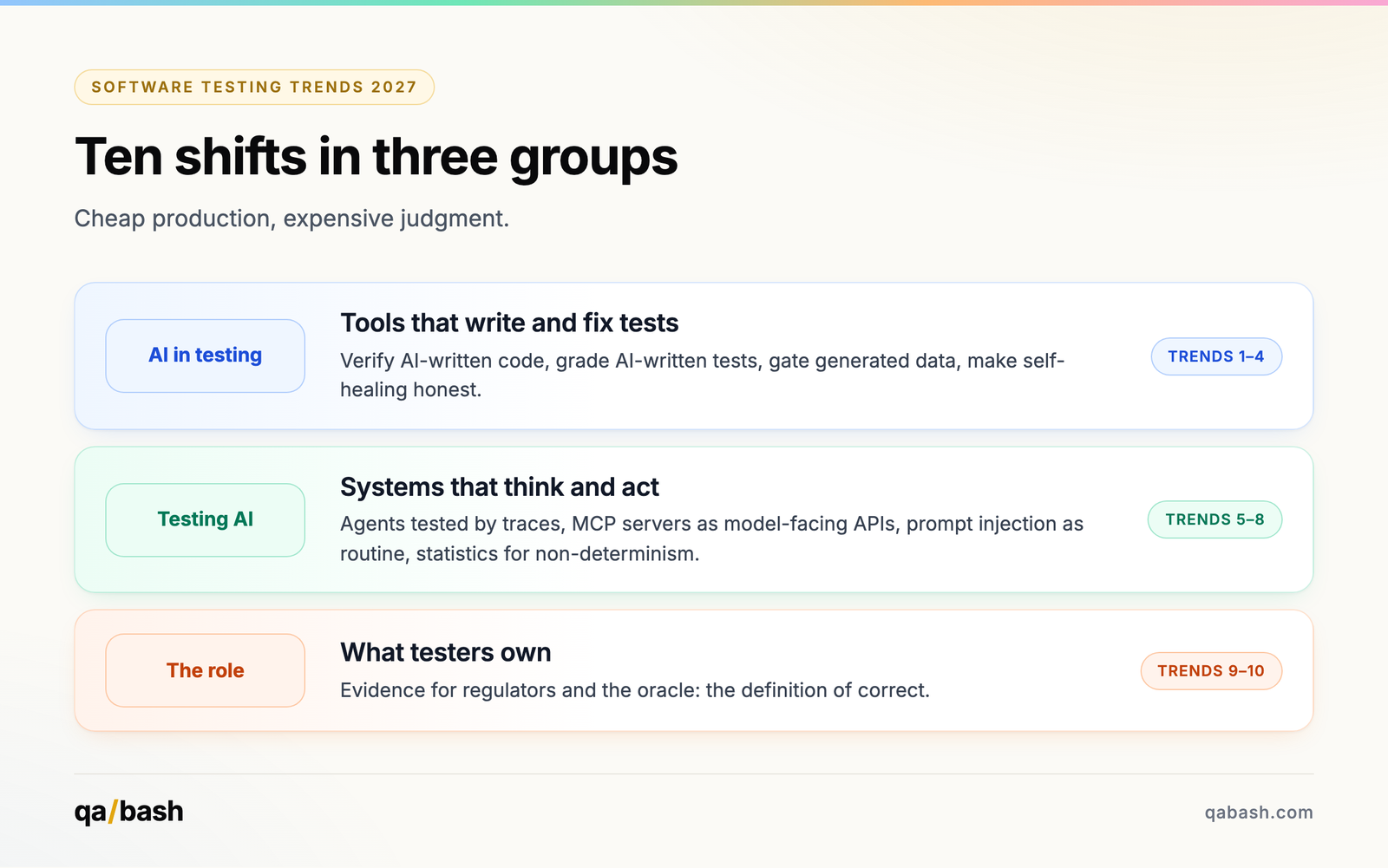
AI in testing: trends 1–4
1. Verifying AI-generated code becomes a core QA skill
Coding assistants and agents now produce a large share of new code, often with tests written in the same session. Those tests share the model’s assumptions, so green CI proves less than it used to.
What changes in 2027: review processes start from the requirement, use property-based tests and treat AI-written tests as claims. Supply-chain checks for hallucinated packages become routine.
Deep dive: Testing AI-Generated Code
2. Mutation testing goes mainstream
Coverage can’t tell a test that checks results from one that only runs the code. AI-written tests are often the second kind. Mutation testing, long seen as slow and academic, is the most direct check of whether a suite would catch a bug.
What changes in 2027: mutation runs on changed critical modules in PRs, especially AI-heavy ones, with the score tracked as a trend.
Deep dive: Mutation Testing for AI-Generated Tests
3. LLM-generated test data, behind a gate
LLMs produce realistic, varied test data in seconds. They also produce invalid rows, duplicates and data that looks uncomfortably real. The winning pattern is generate-then-gate: validate every row, reject with reasons, then freeze the result as a fixture.
What changes in 2027: test data stops being the excuse for thin coverage, and “how was this data produced?” becomes an audit question.
Deep dive: Synthetic Test Data With LLMs
4. Self-healing tests learn to report, not hide
Test frameworks now include AI agents that repair failing tests, and commercial tools heal locators at run time. A heal onto the wrong element can turn a real regression green.
What changes in 2027: teams prefer heals proposed as reviewable changes over silent run-time heals, use intent-based locators, and require outcome assertions after important actions.
Deep dive: Self-Healing Tests: When They Help and When They Hide Bugs
Testing AI: trends 5–8
5. AI agents are tested by their traces
Agents decide their own path at run time, so their replies say little about what they did. Traces do: every model call, tool call, token count and error. OpenTelemetry’s GenAI semantic conventions give those traces a common shape, though they’re still marked Development as of late 2026.
What changes in 2027: the same span-based checks run as CI assertions and as production alerts: tool order, step budgets, token budgets, loops.
Deep dives: Trace-Based Testing for AI Agents · How to Test AI Agents
6. MCP servers get tested like public APIs
The Model Context Protocol is how AI applications discover and call tools. Its 2026-07-28 specification made the protocol stateless at the protocol layer, added server discovery and deprecated older features, with breaking changes. Every MCP server is an API whose main consumer is a model that trusts the descriptions completely.
What changes in 2027: contract snapshots of tool descriptions and schemas, readable tool errors, transport smoke tests and tool-poisoning lints become standard. Websites start exposing tools to browser agents too; WebMCP is experimental in Chrome and its API is still changing, so watch it before you build on it.
Deep dive: How to Test an MCP Server
7. Prompt injection testing becomes routine security testing
Prompt injection still leads the OWASP Top 10 for LLM Applications, and no vendor claims to have solved it. As assistants read inboxes, browse and call tools, indirect injection, hidden in content the model reads, is the larger risk.
What changes in 2027: attack corpora with hard oracles (canary tokens, tool allowlists, link checks) run in CI like any other security regression suite, and defences move from prompts into code.
Deep dive: Prompt Injection Testing: A Red-Team Playbook
8. Statistics become a tester’s everyday tool
An LLM test that passes 9 of 10 runs could have a true pass rate anywhere from about 60% to 98%. Teams that ship on raw pass rates ship noise. Confidence intervals, the rule of three and simple two-proportion tests are enough for most decisions.
What changes in 2027: release gates on AI features are set on interval lower bounds, prompt changes need evidence, and run budgets are sized by risk.
Deep dives: Testing Non-Deterministic AI · LLM Evaluation and LLM-as-a-Judge
The tester’s role: trends 9–10
9. Compliance evidence becomes a test deliverable
The EU AI Act’s obligations for high-risk systems listed in Annex III, such as hiring, credit and education, now apply from 2 December 2027, after the Digital Omnibus moved the date. Those obligations include testing against predefined metrics, accuracy, robustness, cybersecurity and logging. The Act applies to providers outside the EU whose systems are used in the EU.
What changes in 2027: tests linked to requirement IDs, results tied to model versions and evidence generated by CI rather than assembled before an audit.
Deep dive: EU AI Act Testing Requirements
10. Testers own the oracle
Put trends 1–9 together and a pattern appears. AI produces code, tests, data and fixes. What it can’t supply independently is the definition of correct: the requirement, the threshold, the risk, the “this heal changed the meaning.”
What changes in 2027: the most valued testers are the ones who define oracles, design evaluations and decide what evidence is enough. Execution keeps getting automated; judgment doesn’t.
Automation can execute tests. Thinking still belongs to testers.
What to learn first
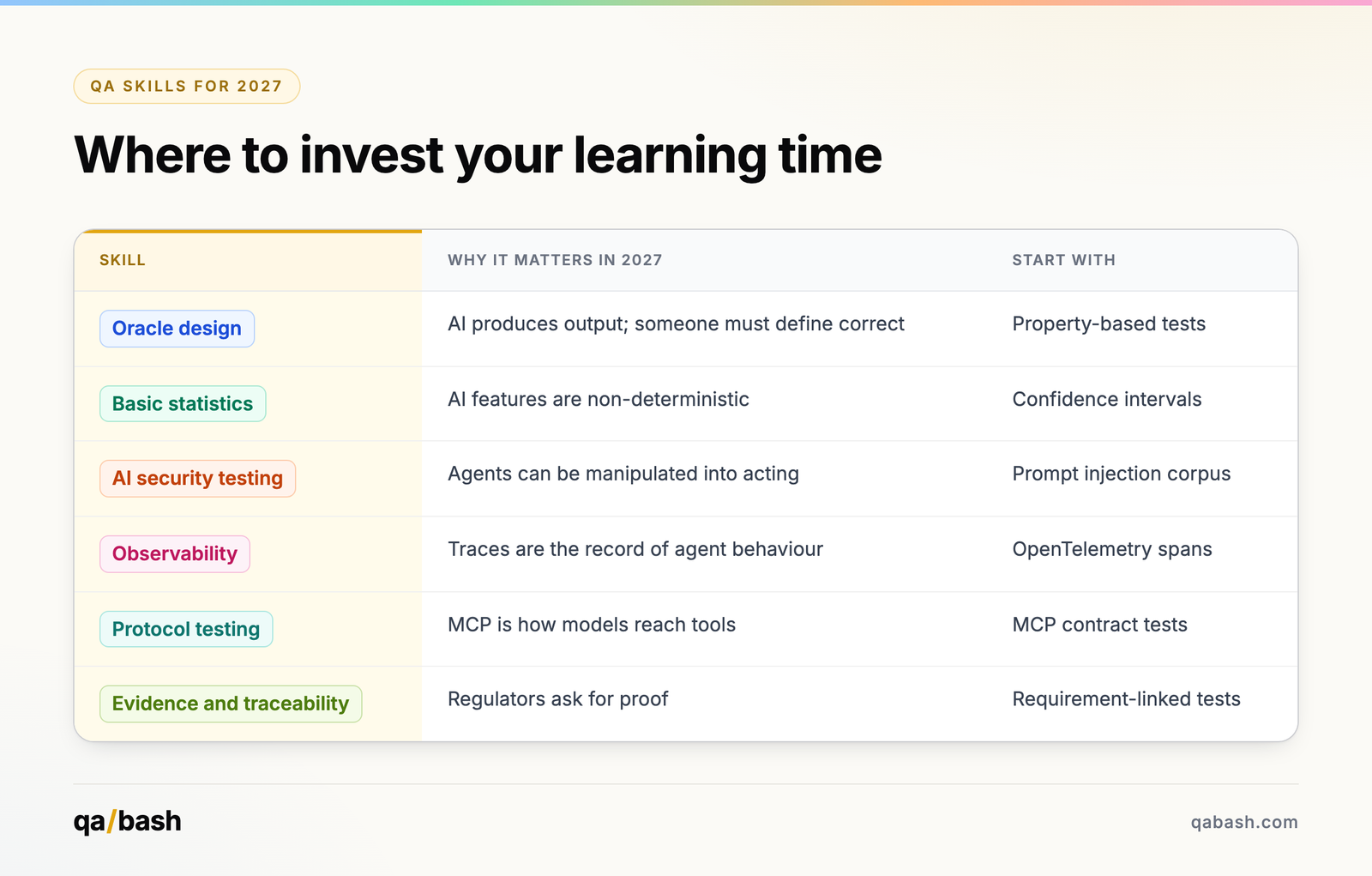
If you only pick one, pick oracle design: writing tests whose expected results come from the requirement rather than from the code. It underpins almost every trend on this list, and it’s a classic testing skill, not a new one. Tools change. Testing principles endure.
Common mistakes in reading trends
| Mistake | Why it happens | Better approach |
|---|---|---|
| Chasing tool names | Tools are visible and marketed | Learn the principle the tool implements |
| Waiting for trends to “arrive” | They sound futuristic | Most are already in production somewhere |
| Assuming AI replaces testing | Execution is being automated | Judgment and oracles are growing, not shrinking |
| Trusting statistics without sources | Trend posts love big numbers | Prefer verifiable changes: specs, laws, releases |
| Learning everything at once | Long lists feel urgent | Pick one skill and apply it at work this quarter |
How AI changes this
AI is the reason for this list, and it’s also how you’ll keep up with it. Assistants make it faster to learn a new protocol, scaffold an evaluation harness or read a regulation. Use them to cut the learning curve, and keep checking their claims the way you’d check any other output.
The pattern to watch in 2027 isn’t a specific tool. It’s where your team’s evidence comes from. If the same model writes the code, the tests and the verdict, nobody has tested anything. A tester who can see that, and fix it, is worth more in 2027 than in any year before.
The best testers don’t just find bugs. They uncover risks.
Checklist for 2027
- Review AI-written PRs from the requirement in
- Run mutation testing on your most critical module
- Put a validation gate in front of generated test data
- Report every self-heal; block heals on critical flows
- Add trace assertions to at least one agent or LLM feature
- Snapshot-test your MCP tool descriptions
- Build a prompt injection corpus with hard oracles
- Gate one AI feature on a confidence-interval lower bound
- Link evaluation tests to requirement IDs and model versions
- Learn property-based testing
Conclusion
The software testing trends for 2027 all point the same way. Producing code, tests and data is getting cheap. Deciding whether any of it is correct isn’t.
Pick one trend from this list that touches your work today, read its deep dive and try the code. In a year, the testers who did that every quarter will be the ones setting the standards everyone else follows.
A bug found in production is expensive. A bug prevented is priceless.
Keep testing. Keep learning. Keep questioning.
Go deeper · QA Bash kit
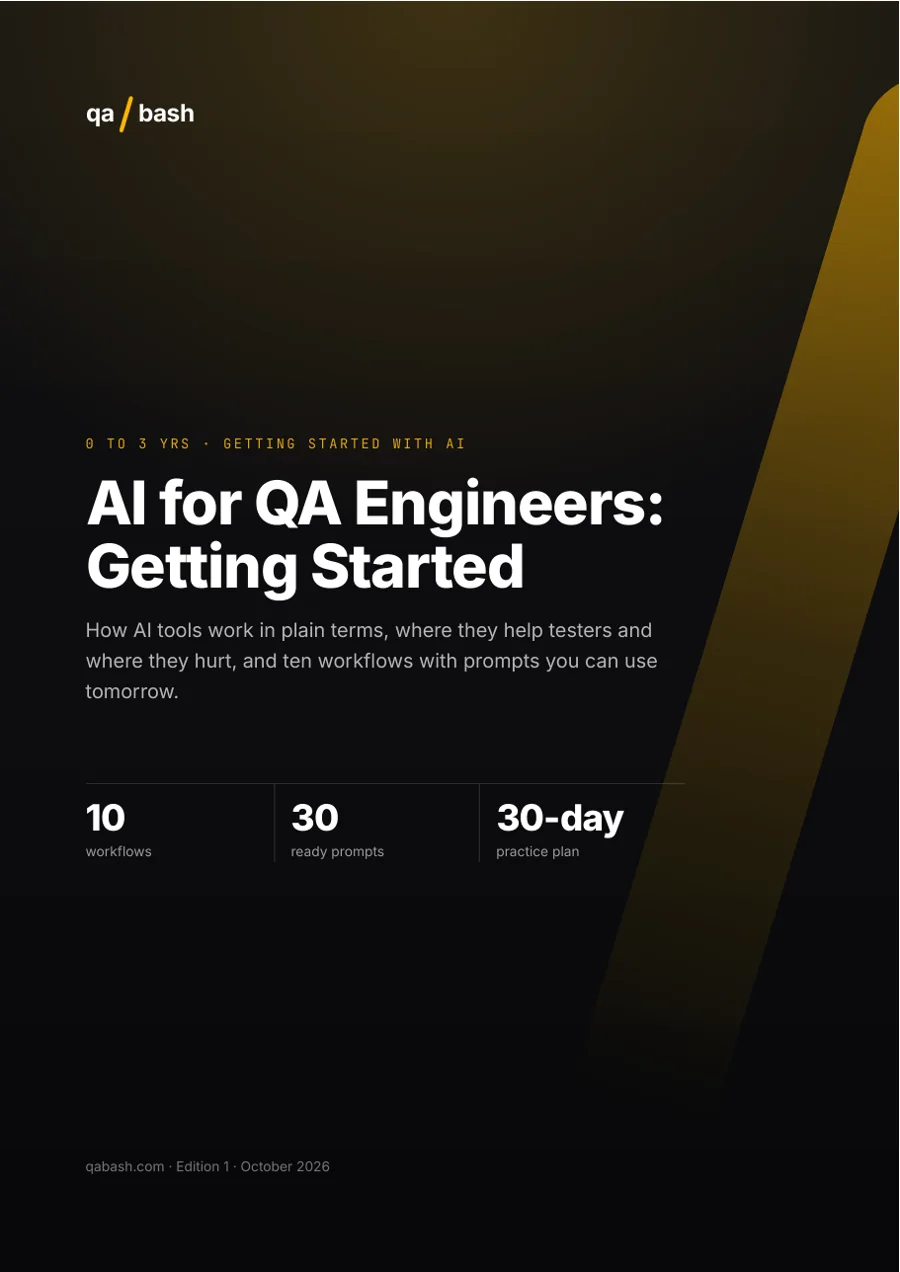
AI for QA Engineers: Getting Started
Use AI tools in your testing work, with prompts that work and checks that keep you safe.
0–1 yrs · 10 testing workflows
₹299₹374
Rate this article
9.2/10 average · 23 ratings
Discussion
Be the first to weigh in
Your question or experience helps the next tester who reads this. Sign in and earn +25 XP for every approved comment or reply.
Written by

Keep reading