Newsletter
One email. Every week. Pure signal.
The week in quality engineering — skip an issue, and you'll wish you hadn't.
20K+ engineers already reading
AI Agent Architectures for Test Automation: 6 Patterns QA Teams Should Know

Oct 16, 2026
The six AI agent architectures that matter for test automation are: single agent (one loop, few tools), planner and executor (a reviewable plan, then execution), retrieval-augmented (grounded in your specs and past bugs), tool-using ReAct (think, act, observe), reflection (draft, critique, revise), and multi-agent (specialists that hand off work). Start with the simplest one that solves the task and add structure only when you can measure the benefit.
Most test automation agents that fail in production do not fail because the model is weak. They fail because the team picked the wrong shape for the job: one agent juggling forty tools, a planner that never checks its own work, or five agents arguing in a loop while the CI bill climbs.
This guide walks through the six AI agent architectures that matter for QA, what each one is good at, where it breaks, and how to choose one before you write a line of agent code. If you need a refresher on what an agent is in the first place, start with our explainer on AI agents, tool use and QA implications.
Why architecture matters for test automation agents
An agent is a loop: it observes something, decides what to do, takes an action through a tool, and looks at the result. The architecture decides how that loop is organised. Is there one loop or several? Does planning happen up front or step by step? Does anything check the output before it reaches your test report?
For testers this is not academic. The architecture determines how predictable the agent is, how you test it, how much each run costs, and how easy it is to explain a wrong result to a developer.
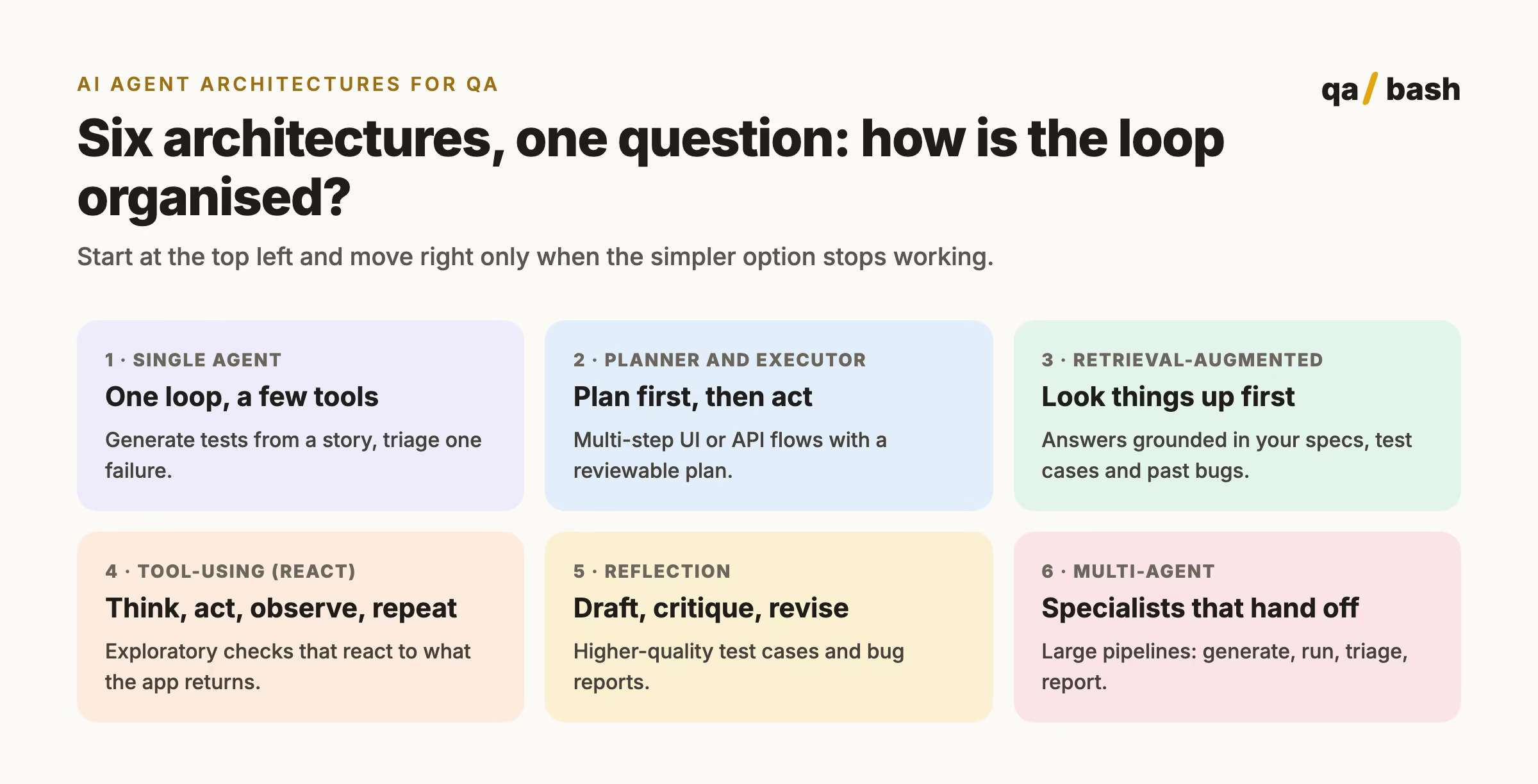
1. Single-agent architecture
One model, one loop, a small set of tools. You give it a goal and it works until it is done or gives up.
- Best for: narrow, well-defined tasks such as turning a user story into test cases or summarising a failed run.
- Strengths: simple to build, cheap, easy to trace.
- Limits: quality drops fast as you add tools and steps. Past roughly ten tools, the agent starts picking the wrong one.
How to test it: a fixed set of inputs with expected outputs, run on every prompt or model change. Treat it like any other function with a contract.
2. Planner and executor
A planner produces an explicit plan, for example “log in, add two items, apply coupon, check total”. An executor carries out each step with tools and reports back. Some designs let the planner revise the plan after each step.
- Best for: multi-step end-to-end flows where you want to see and approve the plan before anything runs.
- Strengths: the plan is an artefact you can review, diff and store with the test result.
- Limits: a wrong plan is executed faithfully. If the app changes mid-run, a rigid plan breaks.
How to test it: test the planner and executor separately. Feed the planner known goals and assert on the plan; feed the executor fixed plans and assert on the actions.
3. Retrieval-augmented agent
Before answering, the agent searches a knowledge base: requirements, API specs, existing test cases, past defects. Retrieved documents are added to the prompt, which grounds the output in your system instead of the model’s general knowledge.
- Best for: generating tests that match your real business rules, or answering “has this bug happened before?”
- Strengths: fewer invented requirements, outputs you can trace back to a source.
- Limits: only as good as retrieval. Stale or badly chunked documents produce confident wrong answers.
How to test it: measure retrieval and generation separately. Our RAG testing framework guide covers the metrics.
4. Tool-using agent (ReAct)
The agent alternates between reasoning and acting: it thinks about what to do, calls a tool such as a browser, an API client or a database query, reads the result, and decides the next step. This is the pattern behind most browser-driving test agents and MCP-based setups.
- Best for: exploratory testing and debugging, where the next step depends on what the app just did.
- Strengths: adapts to unexpected states, works with any tool you can describe.
- Limits: non-deterministic paths, can loop, and every step costs tokens.
How to test it: cap steps and cost, record full traces, and assert on outcomes rather than exact paths. Give it a sandbox: an agent with write access to production data is a defect waiting to happen.
5. Reflection (self-correcting) agent
The agent produces a draft, critiques it against explicit criteria, and revises. The critic can be the same model with a different prompt or a separate model.
- Best for: outputs where quality matters more than speed: test case suites, bug reports, review comments.
- Strengths: catches missing edge cases and vague steps on its own.
- Limits: doubles or triples cost and latency, and a weak critic just rubber-stamps the draft.
How to test it: score first drafts and final outputs on the same rubric. If revision does not measurably improve the score, remove the loop.
6. Multi-agent architecture
Several specialised agents, each with its own prompt and tools, coordinated by an orchestrator or by handing work to each other. A typical QA pipeline: a generator writes tests, a runner executes them, a triager labels failures, and a reporter writes the summary.
- Best for: large workflows with clearly separate stages and owners.
- Strengths: each agent stays small and testable, and you can swap one without touching the rest.
- Limits: the hardest to debug. Errors compound across handoffs, and costs multiply.
How to test it: contract tests at every handoff, plus end-to-end runs on a fixed scenario set. Our post on AI tool chaining and orchestration challenges covers the failure modes in detail.
AI agent architectures compared
| Architecture | Predictability | Cost per run | Ease of debugging | Typical QA use |
|---|---|---|---|---|
| Single agent | High | Low | Easy | Test case generation, summaries |
| Planner and executor | High | Medium | Easy, the plan is visible | Scripted end-to-end flows |
| Retrieval-augmented | Medium to high | Medium | Medium | Spec-grounded tests, defect lookup |
| Tool-using (ReAct) | Low to medium | Medium to high | Hard without traces | Exploratory testing, debugging |
| Reflection | Medium | High | Medium | Bug reports, test suite quality |
| Multi-agent | Low | Highest | Hardest | Full generate, run, triage pipelines |
How to choose an architecture
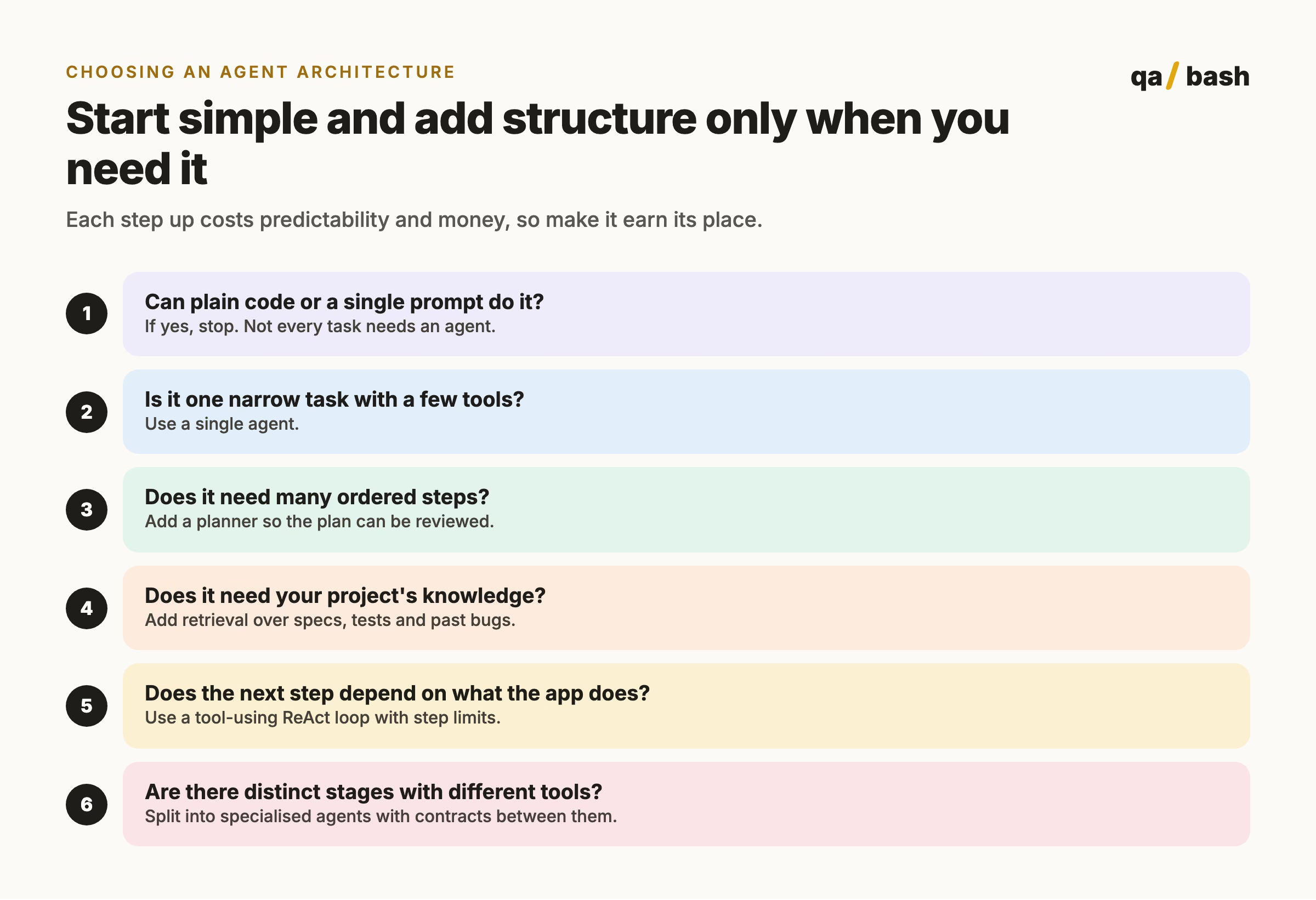
Most teams end up with a hybrid: a planner and executor for the main flow, retrieval for context, and a reflection pass on the final report. That is fine, as long as each piece was added to fix a problem you actually measured.
What every test automation agent needs, whatever the architecture
- Hard limits on steps, time and cost per run.
- Full traces of every prompt, tool call and result, stored with the test report.
- A sandbox: test environments and test data only, never production write access.
- An evaluation set of fixed scenarios you rerun whenever the prompt, model or tools change.
- A human checkpoint before anything is filed, merged or deleted.
Want to see what goes inside each box? Our companion guide to the core components of AI agents breaks down perception, memory, planning and action from a tester’s point of view.
Rate this article
7.6/10 average · 18 ratings
Discussion
Start the conversation
What do you think about this article? Share your experience, ask a question, or add to the discussion.

He’s a builder of communities, a collector of questions, and a relentless challenger of assumptions. While others chase answers, he chases better questions. While others talk about the future of testing, he quietly helps create it.
Frequently asked questions.
What are AI agent architectures?
An AI agent architecture is how an agent's observe, decide and act loop is organised: one loop or several, planning up front or step by step, with or without retrieval, and whether anything critiques the output before it is used.
Which AI agent architecture is best for test automation?
Related articles
Components of AI Agents: A Tester’s Guide to Perception, Memory, Planning and Action
This guide explains the five components of AI agents (perception, memory, reasoning, planning and action),…
5 min
Prompt Testing for QA Engineers: How to Build a Prompt Regression Suite
Prompt testing catches regressions when prompts or models change. Learn which assertions to write, how to…
3 min